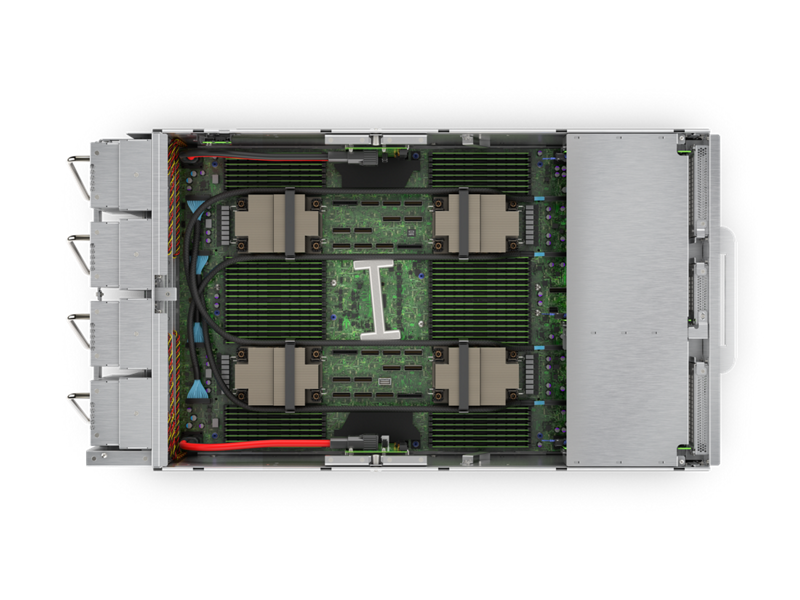
Multiple of these can be linked together with “NUMALink” cables, which carry the same protocol as the traces that go between sockets on the motherboard. You end up with a single kernel running across multiple chassis.
The sport who's leader shoved his head so far up Trump's ass he was able to taste his orange make-up. All for the sake of giving him a farce of a "peace" prize.
(I'm talking about FIFA in case you are not aware)
So... What you are saying is that we don't need 'install.md'. Because a developer can just use a LLM to generate a 'install.sh', validate that, and put it into the repo?
Good idea. That seems sensible.
Bonus: LLM is only used once, not every time anyone wants to install some software. With some risks of having to regenerate, because the output was nonsensical.
> What you are saying is that we don't need 'install.md'
I think the point was that install.md is a good way to generate an install.sh.
> validate that, and put it into the repo
The problem being discussed is that the user of the script needs to validate it. It's great if it's validated by the author, but that's already the situation we're in.
> The problem being discussed is that the user of the script needs to validate it. It's great if it's validated by the author, but that's already the situation we're in.
The user is free to use a LLM to 'validate' the `install.sh` file. Just asking it if the script does anything 'bad'. That should be similarly successful as the LLM generating the script based on a description. Maybe even more successful.
I still dont understand why we need any of them. If I am installing something, It would take me more time to write this install.md or install.sh than if I just went to the correct website and copied the command, see the contents, run it and opening help.
And since LLM tokens are expensive and generation is slow, how about we cache that generated code on the server side, so people can just download the pre-generated install.sh? And since not everyone can be bothered to audit LLM code, the publisher can audit and correct it before publishing, so we're effectively caching and deduplicating the auditing work too.
Good question — we’ve taken that feedback seriously. We’re currently working on making more documentation publicly accessible without a login, so people can evaluate DevicePrint before signing up.
> Don't you dare to compare SQL and CSS. SQL is not a cobbled together mess of incremental updates with 5 imperfect ways of achieving common tasks that interact in weird ways.
Reminds me a little bit of Sascha Baron Cohen's democracy speech [1] in The Dictator ;-)
Both SQL and CSS have evolved through different versions and vendor specific flavors, and have accumulated warts and different ways to do the same thing. Both feel like a superpower once you have mastered them, but painful to get anything done while learning due to the steep learning curve.
Looking at image search for "2020 impreza dash" there's a screen above climate controls in all images. I was asking if there was an option to have no sceen.
I happened to have a piece of scrap wood of the right length already. Making the hole with a hand drill took maybe 2 minutes. Don't think sourcing and installing a lock mechanism would be quicker :-)



reply