(I can only speak to the US, though I expect it's similar in many other western countries as well)
The unfortunate truth is that we have so heavily subsidized and centralized food production that anyone focusing on biodiversity, sustainability, or even animal welfare can compete economically.
If we care at all about any of these goals, let alone all three, the only solution seems to be a much more localized food system. Large-scale ranching and farming is heavily dependent on monoculture, i.e. growing only one type of crop or raising only one type of animal. Without this a farmer has a much harder time mechanising the process with heavy equipment, and that's a must give that exceedingly few people are willing to work on a farm. Even then, most farmers eek out a living based heavily on government subsidies and crop insurance.
I'm raising a small herd of cattle on pasture, I don't have as much experience farming crops so I'll stick with ranching here. Our cows are entirely grass fed and we don't use pesticides, herbicides, or antibiotics. We don't even own a tractor because it's not economically viable to take on the upfront or maintenance costs of modern tractors. No matter how I do the math I could never sell meat or dairy at prices that come close to grocery store prices.
And no, scale wouldn't solve the financial challenge. Raising healthy cattle on pasture requires much more land per head than industrial cattle production offers. Fertilizers, antibiotics, and pesticides are all additional inputs that require expensive equipment to apply properly and ultimately are just bandaids attempting to squeeze out more head per acre than the land can actually support. At the end of the day we would end up raising more cattle, but our expenses and risk would continue to grow at least as fast and we'd end up working harder and stressing out more just to make sure something doesn't go wrong and bring the entire house of cards down.
> We don't even own a tractor because it's not economically viable to take on the upfront or maintenance costs of modern tractors.
This is a little bit ridiculous. A tractor is an invaluable tool and there's tons of them out there that are as old as 60-70 years and still running great. You don't need a brand new GPS-guided john deere with a dealership maintainence plan to work a small ranch; $5-10k will get you something that is old, but easily maintained and will last forever.
Oh I have absolutely looked for an older tractor. Finding a model with parts still somewhat easy to find limits the market, finding one that hasn't rusted out in a field for 20+ years is even harder. The only ones I found within 300 miles of us over the last 12 months were either rusted to hell, clearly lazy paint jobs covering rust, or collectors items that were restored and priced out of the market.
In addition to that, old tractors aren't as capable as modern tractors and are heavy as hell. If the health of the soil is a concern it lsso not ideal to run a 3,000-7,000 pound tractor across the field regularly.
Dont get me wrong, more days than not I wish we had a tractor to make certain jobs easier. I've yet to find one that fits in our budget, is clean enough to be reliable, has parts available when it breaks, and can meaningfully improve the tasks we regularly deal with.
I the meantime we have a Kai truck (Japanese minitruck) that weighs next to nothing and does some serious work around here.
Something like a Kubota L2000 (or any of the many similar ones ranging 12-40HP) fits the bill for semi-modern-ish, light-ish, small-ish, capable-ish, and cheap-ish. It can even run a bucket loader. If I can get one with a mower, roller, and sicklebar tossed in, in Ireland, for €7000, I'd imagine the U.S. will have the same available at half the cost. Don't give up. Bar one guy in Donegal, EVERY regen ag hippie farmer I've met (who didn't go under) was all "we don't need a tractor" at the outset and owned one inside of 5 years. Any sweat you spend doing things a tractor can do better and faster inside your cost envelope is sweat wasted. https://www.tractordata.com/farm-tractors/006/8/8/6882-kubot...
Why limit the search to 300 miles? I imagine paying for shipping on a cost effective tractor would be worth its weight in gold in the long run. (financial situations very greatly I know)
It's one of those things where you have to take a look in person before you buy it. 600 miles round trip is relatively easy to drive in a day without staying overnight.
Totally agree! And my advice is to find something in the 30hp zone. The yard tractors are not as generally useful from a mechanical advantage standpoint. Tractors aren't just "tillers and mowers". Along with levers and pulleys, the tractor can be seen as a general purpose force applicator.
But it can often be better to get an older tractor, as they can be easier to repair and maintain than the newer ones.
You don't need to go back 60-70 years to the bad old days of 9Ns with leaking carburetors, slipping clutches, and transmission-driven PTOs. A 20-30 year old 4WD compact tractor with a diesel engine, hydrostatic transmission, and independent, live PTO can similarly last forever and be easily maintained (as long as you don't buy a Deere).
I'm hoping the pendulum swings back toward the middle of things. A huge push for centralization and subsidization was to ensure domestic food security. Famine or blight in one region? Overproduce a bit in another and ship it to those people.
But somewhere along the way it flew way, way past that and created a huge opportunity for business profit. Excess production with subsidies...
> The unfortunate truth is that we have so heavily subsidized and centralized food production that anyone focusing on biodiversity, sustainability, or even animal welfare can compete economically.
Isn't centralized agriculture more efficient on a calories-per-acre basis? You even say that you can't raise as many cattle as industrial cattle production. Also, the more people we can feed with land in places like the US Midwest, the less land we need to use in places like the tropics which are more important from a biodiversity standpoint.
> Isn't centralized agriculture more efficient on a calories-per-acre basis
That's exactly the problem, the entire industry is built on metrics that revolve around calories and poundage. The calorie is an absolutely useless metric by itself and says nothing of nutritional value. Similarly, a pound a beef is not always the same and nutritional value can vary wildly depending on how the animal was raised.
Moving all production to one place like the US Midwest only externalizes the costs for everyone else. Centralizing that dramatically leaves the Midwest in a huge whole with regards to input requirements - they have to ship in fuel, fertilizer, feed, etc from other areas. Not to mention the cost of processing, preserving, and shipping that product back to customers hundreds or thousands of miles away.
Centralized agriculture is not necessarily more efficient compared to localized agriculture, because centralization introduces additional machinery, transport costs, pesticide/fertilizer research/production/shipping etc etc. centralized agriculture is actually a huge resource suck compared to localized methods, which puts a huge thumb on calorie-per-acre net.
On the other hand, it's easy to teach a few large farmers best practices from ag and soil science. The more decentralized agriculture becomes, the more individuals have to educate themselves. Do you trust your next door neighbors to become ag scientists to be good stewards of their land?
She is an ag scientist and and damned good one to by all accounts, co owner of a regional ag consulting group.
For that matter the chap down on the corner is in the grain seed ANOVA business, he has thousands of test plots all over the wheat belt region.
What's always happened here is that everybody multi skills - not everbody is an ag scientist, but everybody knows someone who is - ditto diesal mechanics, well borers, drone operators, tractor hackers, silo builders, etc.
It turns out that by building networks of producers who share their experiments as they try to find best practices for their specific place, time, and crops for regenrative ag actually helps them improve it for their context and make a little money.
The problem with ag scientists is that they stay in universities, grow a few test crops in their own fields, then try to replicate that at scale a hundred miles away. Then they throw their hands up when the producers tell them they're full of it.
On the other hand when you build real social networks of producers they can find more common ground and share stories about practices that work.
It helps too because it's actually _their_ next door neighbors who don't use sustainable or regenerative practices who are coming over and telling them they're doing it wrong. IOW the isolation that comes with the decentralized ag that you're talking about is also a social isolation that makes it really hard to even experiment.
The problem with industrial farming isn't an education bottleneck, it's an incentives bottleneck. Family farmers treat the land like a legacy to be passed onto their children--they don't necessarily know that they're depleting the land, and as such education is a bottleneck. But industrial farmers know they're exploiting the land to make as much money as quickly as possible. They're perfectly happy to exhaust the soil because they can make a bunch of money and still sell the depleted land for a profit later on.
Educating small farmers is a big task but it's at least actionable--I have no idea how you could go about making corporations care less about profit than they do about sustainability.
> The problem with industrial farming isn't an education bottleneck
The problem of industrial farming is the education bottleneck, though. There is good reason why virtually all farms in America have remained family farms. What growth in farm sizes we've seen has been mostly on the back of machinery and other technical innovation allowing families to do more work, and not so much farms being able to hire more and more labourers. The latter has not happened in any significant way because educating farmhands about agriculture is a monumental task. And if you manage to pull it off, there is a very good chance that they will soon want to become the farmer running their own family farm!
> There is good reason why virtually all farms in America have remained family farms.
This is the wrong metric; we don't care about the number of farms, we care about the amount of agricultural productivity. Large scale family farms and industrial farms account for more than half of all agricultural output in the US (USDA (2021) America’s Diverse Family Farms).
> What growth in farm sizes we've seen has been mostly on the back of machinery and other technical innovation allowing families to do more work, and not so much farms being able to hire more and more labourers.
I agree--in fact, larger machines and more automation allows large operations to reduce labor costs in ways that smaller family farms can't compete with, which is helping to squeeze out small family farms.
> The latter has not happened in any significant way because educating farmhands about agriculture is a monumental task.
No, it's because farmhands don't have access to capital to buy land and equipment. Farmhands understand agriculture, moreover, even if you can buy a small farm you'll be working 80 hour weeks to break even--you have to have a large operation in order to keep your head above water (the only really viable small operations are selling prestige 'organic / locally grown / free range' foods to yuppies and even then I'd bet many of those farmers feel pretty strapped). Anyway the farmhands aren't the ones calling the shots on how the land is managed, they're shoveling shit and driving the tractor where and how they're told.
It's not intended to be a metric, just a matter of fact. Industrial agriculture has never really taken off in any meaningful way because it is too hard to educate workers about agriculture.
Anyone who already has that education does so most likely because they have been involved in a family farm, and thus are likely to be still involved in that family farm. Very few people leave the family farm to work for an industrial operation.
It is true that some family farms have been able to leverage technology to grow quite large and supply a significant portion of all the food produced, but they are still family farms. A family farm isn't determined by its scale.
> No, it's because farmhands don't have access to capital to buy land and equipment.
In my first couple of years of farming, I rented or hired out everything I needed. It is false to claim that you need to own capital to farm. In the long term I would agree it is prudent to start investing in those things, hopefully from the proceeds of your earlier years farming, but you most definitely don't have to begin farming as a BTO. You can get started with a surprisingly small investment.
What would have absolutely destroyed my farm business would have been not having some farmers readily available to share their experience with me and to help guide my operation. I agree that most people don't have access to that. For that reason, most people will never realistically be able to start farming, even with all the money in the world. I mean, of course anyone can live up to the "How do you make a million dollars farming? Start with two million." trope, but I wouldn't call that realistically starting farming.
> Anyway the farmhands aren't the ones calling the shots on how the land is managed
Absolutely. They are going to be the actual steward of the land, though. An industrial farmer isn't going to be the one doing the work.
When was the last time you saw a worker listen to shots called? I've worked in a lot of industries in my life and I've never seen workers listen to the shots called. They do whatever the want. They don't care if they destroy your equipment or land. What's it to them? They'll just go get a different job if you don't like what they decided to do.
Thanks to advancements in automation, more and more work can be given to computers who will listen to the farmer, leaving the worker to just sit there and make a phone call to an expert if the computer fails. This is making the industrial farm idea more realistic, but we've only covered a very narrow swath of farming activities with such automation to this point.
I think the incentives are more aligned than you think. Healthy land is productive land. Look at the adoption of no-till farming, cover cropping, crop rotation, etc. Plus inputs like fertilizer and pesticide is expensive.
I think a lot more is wasted by the millions of smallholder turfgrass farmers in the suburbs than major food producers.
> it's easy to teach a few large farmers best practices from ag and soil science.
But much, much harder to teach their workers who actually steward the land on large farms. Farmers have some incentive to listen, but farmhands couldn't care less. They are just there to collect a paycheque. The long-term viability of the operation means nothing to them – they can always get a job somewhere else. The more decentralized farming, the more farmers, and thus more people who have reason to care and fewer people who have no reason to care.
>> Do you trust your next door neighbors to become ag scientists to be good stewards of their land?
I expect the people intending to produce good, healthy, and natural food to be more able to do so than those who follow FDA standards with the sole intention of making money.
Centralized-vs-distributed is mostly a matter of efficiencies of scale vs transportation, and efficiencies of scale almost invariably win. Pesticide/fertilizer/etc are all orthogonal (there's nothing preventing local farmers from using pesticides and fertilizer). In particular, the machinery costs per acre are lower for centralized agriculture than for distributed agriculture, but the transport costs are higher (although not as high as you might think because the costs of moving things around the country are shared broadly--not just by food producers). Besides machinery, personnel costs are much lower for centralized agriculture.
There are a lot of advantages to local agriculture, but 'cost' isn't one of them. I would like to live in a world where more food is grown locally, but that means we have to solve (and not ignore) the cost problem--how do we afford the additional machinery, personnel, etc costs that are passed along in food prices without pricing out poorer people?
Absolutely is. Especially in meat production where you can have good quarantine practices in factory farms and test at scales. We choose not to because fda has no teeth but we could and it wouldn’t add much cost
It is not possible to compete on price with feed lots, only on quality. Feed lots are more efficient if the only thing you're measuring is weight of meat per acre.
Unfortunately that is how the industry works though. There are small niches for providing high quality meat and dairy, but the market is tiny in comparison and can't come close to competing on price.
Regulation is also a big blocker. It's not even legal to sell raw milk for human consumption in the US, and for red meat it all must be processed by a facility regulated by either the state or federal government (depending on if the cuts of meat will cross state lines). If you've ever seen how USDA processing facilities operate, its far from what anyone would consider humane and if you would rather not eat meat that was sprayed with bleach you have to look somewhere else entirely.
You are right, it is a small market. I am surprised about the raw milk, though, I read of places in the US that sell raw milk, cheese, etc. Maybe it is legal in some states? I also heard of companies that go to your farm to put down your cattle (also in the US) so you don't have to send them to a slaughterhouse. Again, niche stuff but nice to know it exists.
I'm guessing without the subsidies our food prices would go way up and we would still probably have a lot of farmers going out of business (because many farmers are dependent on international markets that they would no longer be able to compete in)? Maybe we could address food prices by expanding "food stamps" programs, but I'm not sure what kind of policy would keep small farmers in business. And I would think mandating organic, local, small scale, etc agriculture would only make food even more expensive? (I'm not inherently opposed to expensive food as long as it doesn't worsen food insecurity).
I'm curious how Europe does it--do they just import their food from countries that can produce more cheaply (because of cheap cost of living / dodgy labor laws)? More expansive welfare to help people buy costlier food? Both?
I won't speak for Europeans, I lived there for a few years but not long enough to understand their system deeply enough.
I agree though, removing subsidies would destroy many of the farms that exist today. It's a prime example of the risks of welfare programs, they are presumably all run with very good intentions but in this case the industry is so wholly dependent on the subsidies that we can't remove them. The problem there is a broken system can only be propped up so many times, and the more you pile on top of it the worse it is when it finally collapses.
Hopefully people wiser than me can orchestrate a soft landing here, because I can't personally see how we safely transition our food industry off the centralized, subsidized model.
> It's a prime example of the risks of welfare programs, they are presumably all run with very good intentions but in this case the industry is so wholly dependent on the subsidies that we can't remove them
I don't think this can reasonably be interpreted as a cautionary tale about subsidizing food prices because even if we never subsidized food production, the alternative was starvation among the poor, which seems strictly worse. Yeah, we have a system that is dependent on subsidies, but that's precisely because human beings are necessarily dependent on food. As far as I can tell, the only way to avoid both subsidies and starvation is to drastically reduce inequality.
I could also believe that we shouldn't subsidize food production, but rather we should have essentially expanded food stamps--basically give poor (and maybe even middle class) people a food stipend to offset the rising food costs.
> Hopefully people wiser than me can orchestrate a soft landing here, because I can't personally see how we safely transition our food industry off the centralized, subsidized model.
"Centralized" just means "more efficient" and thus "lower cost". Transitioning away from that model necessarily implies higher costs, which means you need subsidies so people can still afford to eat. Moreover, I don't think you're going to transition as far away from "centralized" as people think, because most of the country doesn't have the climate and geography to support local farming at the scale required to feed people (especially along the coasts). Moreover, you're just not going to grow bananas, citrus fruit, etc at scale in northern states.
A lot of the problem is that it is hard to compete on quality in a commodity market (even taking into account usda quality tiers).
How do you convince someone to pay 2x for your beef vs the feed lot competition (especially when the steaks look pretty similar side by side in the butcher case)
"The unfortunate truth is that we have so heavily subsidized and centralized food production that anyone focusing on biodiversity, sustainability, or even animal welfare can compete economically."
...Compete... With what? I don't understand what you're saying.
Farms can't compete with farms?
To me it seems such a statement's validity would vary wildly because the value of land relative to intentions for agriculture or conservation, is dependent on geography.
It's not as though all areas receive the same subsidies or even need them. Nor do we know what subsidies or amounts are even being discussed. The whole statement just seems vague and undefined to me.
Say we're discussing private real estate in the context of agriculture & ecology-- Focusing on biodiversity, for example, has a much different ROI and perspective on that ROI, on the boundaries of a national park vs in a suburban neighborhood.
> The unfortunate truth is that we have so heavily subsidized and centralized food production that anyone focusing on biodiversity, sustainability, or even animal welfare can compete economically.
I don’t believe this, because the Amish down the road present a living counterexample. They are not only self sufficient, but they produce a surplus of frankly superior food at competitive prices.
Likewise you can get healthy and affordable (average around $3 per pound) beef from a local farmer by buying a share of a cow on the hoof and then taking your share after slaughter.
The two main “catches” that come to mind are that you only get fresh food when it’s in season and you need some kind of preservation story for when it’s not.
Since you admit your relative lack of expertise, I caution you against extrapolating too much from your personal anecdotes.
A few months ago, I have become member of a farming co-op just 8 minutes biking from where I live (in the Netherlands). The co-op aims at sustainable food production with some livestock. Increasing bio-diversity is one of the primary goals. The co-op leases about 30ha hectares which in the past decades were primarily used for producing corn to feed cows. There are about 18 farming co-ops like this in the Netherlands [1]. I very much enjoy helping with the weeding.
There is a lot of criticism about Herenboeren initiatives though:
- The lack of knowledge (or wilful ignorance) results in them not requesting permits like other farmers have to, resulting in frustrated neighbours and a bad reputation.
- The lack of knowledge (or plain arrogance) results in trying to turn soil that is unsuitable for vegetable cultivation into vegetable gardens, resulting in failed harvests and wasted money. It's fine to experiment, but throwing money away while well meaning neighbouring farmers are proactively giving you all information you need to know is something else entirely.
- Some farmers that are employed by the communities are frustrated because of endless meetings and politics.
- Like with a lot of homesteading initiatives, the end goal often seems to be make money on rent and knowledge sharing and not creating a sustainable business based on produce. The same goes for Youtube channels of people promoting the lifestyle. Without ad money it's unsustainable.
Overall my gut feeling is that initiatives like these will only result in glorified allotment gardens and it will never be able to achieve its goal of reinventing food production.
It would be way better to let existing farmers incorporate better practices at scale.
I was not aware of this criticism. I also do not know if the expressed criticism is valid for every farming co-op. The one I am involved with is working in close cooperation with the local government. Even the planting plans are agreed upon with the local government from which the lands are leased.
The farmers I have talked with seem knowledgable and one of them has been running her own biological farm for 29 years.
I am not sure whether it can compete with commercial farming. At the start of year a bio-deversity measurement was performed at which at three places one square meter was examined. I understand that only one earthworm was found. This year, a lot of rye was sown (together with flowers) in order to improve the quality of the soil. I understand that soil improvement is a slow process and needs many years.
From what I hear in the news, I understand that food production in the Netherlands is strongly influenced by big agracultural companies (who focus on scaling up and reducing the number of farmers) and that farmers who want to transition to biological farming often experience a lot of resistance from banks.
Herenboeren doesn't have to compete with commercial farming directly. It only has to be good enough that participants are willing to join, which they are. So the overall deal needs to be attractive enough.
And we have several important advantages. If there's a small piece of scab on an apple or a single harvest of beans fail, it is generally not a problem for us, whereas these things are problematic to regular farmers. Furthermore, we don't have to deal with supermarkets setting prizes and with logistics.
Our 'customers' pay upfront and each month so the income is very steady - there is generally a waiting list for these farms. Finally, the farm(ers) are supported by a national network of specialists and advisors.
I believe these advantages allow us to potentially outperform commercial farmers, although it might not make sense at all to compare the operations.
Herenboeren Usseler Es is working together with the ITC institute of the University of Twente in a project that is called 'Developing climate smart water management in agriculture on a farm run by citizens' [1]. For this project a weather station has been installed. At two locations sensors have been installed to measure the humidity in the soil at various depths. Remote sensing techniques have been used to measure crop rates. For a short video (in Dutch) about this, see [2]. The ITC is the former International Institute for Geo-Information Science and Earth Observation that from 1 januari 2010 has been incorporated by the University of Twente.
Do you have some source of this criticism? I am also a member of one of these initiatives, and I imagine a lot depends on the specific cooperative. Is this coming from your personal experience?
> The lack of knowledge (or wilful ignorance) results in them not requesting permits like other farmers have to, resulting in frustrated neighbours and a bad reputation.
Don't recognize that at all with my farm, we spent 3+ years getting permits before we were even allowed to start farming (on an existing farm!). But who knows.
> The lack of knowledge (or plain arrogance) results in trying to turn soil that is unsuitable for vegetable cultivation into vegetable gardens, resulting in failed harvests and wasted money. It's fine to experiment, but throwing money away while well meaning neighbouring farmers are proactively giving you all information you need to know is something else entirely.
First of all I don't think its a good look to assume malice based on one case (wilful ignorance, plain arrogance) and generalize that to the whole movement.
A lot of the farmers are actually reasonably well educated and knowledgeable, but a mixed farm such as this is a very complex operation. A lot of regular farmers specialize in a handful of crops, or in animals, or in trees. But mixing 50+ crops with animals and an orchard _and_ dealing with volunteers and a cooperatively owned farm: this is no piece of cake. So, for sure there will be mistakes.
However, I don't recognize this at all at my farm, even in the first year we had an abundant harvest and we are just getting started.
> Like with a lot of homesteading initiatives, the end goal often seems to be make money on rent and knowledge sharing and not creating a sustainable business based on produce. The same goes for Youtube channels of people promoting the lifestyle. Without ad money it's unsustainable..
This is just wrong. For starters, it is not a homesteading initiative! It is real farm on a medium scale, supplying about 500 to 700 people with fresh produce, meat, eggs, fruit and sometimes grains (but mostly grains aren't done). The difference with a 'normal' farm is that the farmer is paid a decent _wage_. The consumers are also the legal owners and bear the risk, not the farmer. There are no supermarket or other middle-men involved. We have a very direct connection with the farmer.
But most importantly, there is no end goal of making money. You can buy a stake in the farm to become co-owner, but the legal contract says you are not allowed to sell it at a profit. We are also forbidden from selling the food. Any surplus we have we give away to charity.
If we are done producing food to feed ourselves, we can relax, make the operation cheaper, or produce food for the wild animals or whatever. But we can't make money.
I can't stress this enough because this in my opinion is the most important innovation of herenboeren: we collectively fund the (ecological sound) production of our own food, which is the only goal. In fact we have legal precautions in place to block anyone who attempts to make money from this initiative. It is funded by the 500 to 700 owners and this is enough to pay the farmer a living wage, lease the land and run the farm. We just get food out of it, nothing more. This is it, very simple. In a sense, we have taken free market capitalism out of food production. Not completely of course, participants will leave if we don't deliver, but to an interesting degree.
> Overall my gut feeling is that initiatives like these will only result in glorified allotment gardens and it will never be able to achieve its goal of reinventing food production.
You are wrong on several assumptions and at least part of your conclusion as well. It is definitely a real farm, providing real food, to real people. There are now 18 in operation, feeding around 10000 people. There are dozens more in the process of being started. There are problems with the herenboeren concept, but you haven't touched on any in your criticism.
I think reinventing food production is too bold a claim, but it is real, it works and it is here.
> What makes a soil suitable for growing vegetables?
There are many factors. Sand/clay mixture (I think there are other types of "rocks" that make up dirt as well). How much organic matter is in the soil. How much water is available (which in a function of both the above and local rainfall). How loose/compacted the soil is. What temperature the soil is. How deep the various soil layers extend. Fertilizer is good, but different plants need different amounts (2-4-d was developed has fertilizer but it is mostly used as a weed killer) There is probably more that I can't think of. Note that the right soil for one type of vegetable is often wrong for another. There isn't a one size fits all.
> What can we grow in a soil that isn't?
That depends on what you have. Desert soils can grow cactus (add water and they can often grow more). I've seen trees grow in the cracks of rocks.
> Is it possible to transform an unsuitable soil into a good one?
Define good? Do you care about costs? Around me there are a number of places where coal strip mines closed 100 years ago, and the soil was good for a few scatter weeds, the DNR has a grant program to transform those into grass land, and in 3 years that bare ground can support cows but it will be thousands of years before it can grow corn. Global warming will melt permafrost and those areas will then support plants, but they will never support tropical plants (at least not assuming any likely level of global warming). Modern housing developments strip away all the top soil but gardeners often buy enough manure to redevelop the soil into a garden - at great expense. Depending on how you define good you can get very different answers.
As a complete outsider, I found this fascinating series of talks a few years ago that go into great detail on soil for farmers: https://youtu.be/uUmIdq0D6-A
Wow, that's quite an unfortunate name to use for a farming co-op. You can tell it wasn't started in the North of the country where the historical 'herenboeren' were an actual thing.
People are pining for the romantic past where uneducated peasants were living like slaves doing back braking work for their herenboer. OP should read up on the history here:
https://ottoknot.home.xs4all.nl/werk/1929.html
They were basically the ultra-rich landowner class. The actual farm laborers doing all the work weren't quite as well off. There's a reason that area still has the last traces of the communist party still active in local politics.
Check out a documentary called "The Biggest Little Farm" for a US based farm that created true bio-diversity/ecosystem, and used it instead of pesticides to grow food.
I'd also recommend Syntropic Agriculture, an agroforestry method pioneered by Ernst Gotsch. He personally reforested 500 hectares of degraded pastures and doesn't use any external resources such as pesticides and fertilizers. Instead, he employs methods like maximizing photosynthesis and selective pruning.
As a result, his land now stands as one of the most fertile and biodiverse regions within the Atlantic rainforest, achieving even higher yields than traditional farms. As syntropic farmers often say, they grow the soil to grow the food.
Another example would be the Natural Farming method pioneered by Masanobu Fukuoka. He also practices farming without the use of pesticides and herbicides, and his yields also surpass those of traditional farms.
I've been doing syntropic agriculture for over 7 years now. Ernst is no doubt a great teacher! But I would be careful with claiming it has better yields, it really depends on how you are measuring it, you might get better yields per plant, but not per square meter if counting only 1 crop, but since you have multiple crops in the same space (separated by time) the yields are better in general.
Its beautiful to see a coffee plantation where the trees got pruned right before the coffee flowers, that makes the best harvest per plant no doubt.
The best bigger scale syntropic system I know so far is Mata do Lobo https://instagram.com/matadolobo they are really mechanizing a lot of those processes are really digging into the soil ecosystem, its worth checking them out.
If the yield is better, why don't more do it? Is it just because it takes more skill, basically? In other words, what are the economic incentives working against adopting this farming method? I'm very interested because this type of farming sounds wonderful to me.
A lot of these methods aren't easy to scale (yet) and depend on the outstanding expertise of individuals. There are also various incentives and circumstances that work against it, depending on the country where you live:
- you can't get loans from the bank because its not a proven method (applies to food forests or other types of agroforestry, not to organic farming anymore)
- you need some time investment to get the operation profitable, can be as much as ten years for a food forest
- regulations may prevent you from acquiring land, simply because the method isn't known
- you may not get subsidy and / or tax cuts because you have a different system or produce different crops
- the crops you produce may not always get the best prize on the market
- you simply aren't profiting from externalized costs, hence you are less competitive
An example of the last point: to support our meat and dairy industry, the Netherlands imports cheap soy from Brazil, which is produced by destroying millions of hectares of rainforest. This is a bit like fossil fuels (also used a lot in agriculture): it isn't sustainable and it is taking advantage of cheap labor and destroying natural resources elsewhere. If you want to produce meat or dairy in a sustainable way in the Netherlands without taking a toll on the Amazonian Rainforest, you will need a lot of land which is very expensive, and therefore you aren't competitive anymore.
The promises of syntropic farming are many: large yields; multiple income streams; optimal use of land; no need for external inputs; improved soil quality; minimal weeding; plant resilience due to biodiversity; and better water management, both in extreme wet and dry times. Gietzen tells the story of Götsch’s cacao farm, showing that an established syntropic system can sustain high productivity with a level of labor that is comparable to that needed to manage a conventional farm. However, syntropic farming can be complicated to understand and apply. It requires in-depth knowledge of biological processes, access to many different kinds of seeds, and careful management.
He refused to use artificial fertilizers and pesticides. He let most of the land grow naturally, and on 12 hectares (30 acres) he planted bananas and cocoa, cutting back the surrounding trees regularly. Today, he harvests an average 920 kgs (2,000 lb) of cocoa beans per hectare, more than three times the average across Brazil of 300 kg (660 lb) per hectare. And because he doesn’t spend money on fertilizers and pesticides, unlike the farmers around him, Götsch enjoys higher profits.
...
Then a drought hit the region. But not on Götsch’s farm. The dense vegetation of the 120 hectares locally created a lot of evaporation and the rain continued to fall. His success as a “rainmaker” finally earned Götsch the respect of his neighbors. They started to imitate him. Today, the forested area in the surroundings spans 1,000 hectares (2,500 acres). “When you fly over my finca now, you can’t see it anymore, because it is covered by clouds all year round,” Götsch says proudly.
It has nothing to do with attention or skill. Food forests are simply bad businesses. If they weren't, we would see adoption pretty quickly. Idealism only takes you so far, in the end people need to make a living.
Food forests also don’t do well producing the most highly subsidized crops (rice, cotton, feed corn & soy, etc).
I don’t know if they’d be viable vs non-subsidized farms either but in the US it is really hard to have a conversation about farm profitability without looking at how the government puts their finger on the scales.
US farm subsidies come in two forms: crop insurance (for the major crops you list) that ensure farmers can have some bad years/crop failures and not lose the farm; and CRP where the government "rents" marginal land so that farmers don't attempt to farm it (in drought years they will allow taking one crop of hay).
At one time there were a lot more subsidies, but not anymore.
There are all manner of “hidden” subsidies for commodity agriculture. The CFTC for instance runs out reach on agg derivatives even when they are low volume contracts (cheese).
Food forests are only bad business because bad business has made it so.
Where food forests win, is where people don't want mono-culture food products, and prefer to grow - and eat - locally.
Of course, if you've never stepped off the grid, you can't look at it, critically. If you have, you may wonder why you ever lived on it, in the first place.
We'd all be much, much healthier if we could eat locally, and grow our own foods - in whatever manner is feasible - instead of burning oil to do it.
I'm always surprised that people think farming isn't like any other industry in capitalism. They will aim to make as much profit with resources they have available.
If doing farming differently would certainly net more, they would do it. So I take there is some component that is forgotten. Be it scaling, labour input or available market for higher priced products.
In a lot of countries people still think farmers are stupid. Because of that a lot people think that even amateurs can do a better job, as long as they are not a traditional farmer.
They said nothing of the sort. People in here are passing this method of farming off as a settled fact that it is better, when even Gotsch says it is still experimental and admits using fertilizer would boost yields of wheat, soy, and maize. Dropping yields of some of these key crops in the world's calorie consumption nearly 30% would be devastating to countries that depend on imports.
> I'm always surprised that people think farming isn't like any other industry in capitalism.
They probably don't see farming as being like capitalism because farming is, with some exceptions, mostly socialist in nature – the workers own the means of production.
> They will aim to make as much profit with resources they have available.
That is certainly true, although not a feature of capitalism. Wanting something in return for offering something to another transcends capital ownership structures.
Based on what I've seen in cities, something tells me that many of the neighbours will complain of pests and get regulators involved to prevent the food forest approach. I'd like to see otherwise though.
That farm would be unable to exist without making documentaries, cook books, seminars and guided tours. I'm way more interested in what policies and changes can be used to nudge traditional farming into more sustainable (both financially and ecologically) practices as we need farmers that are able to make a living without becoming a marketing project.
I always wonder about things like scaling and sustainability with these movements. Do we need to move some labour back to agriculture with changes they want? And were will the pay for those jobs come from? As surely they should be well paid jobs, right? Right?
So what will be the affordability at the end for food in general?
The vast majority of people would rather eat crap and buy another toaster they don't need and add another bathroom to their house they'll hardly ever use then spend more money on quality food.
Small farms can be sustainable as a business model, and I know some (namely, the ones I buy from at farmers' markets), but it's rough going.
Then again, all the few homesteaders I know have a person employed in big tech or fintech who makes the investment possible, but that investment can yield a homestead farm that can eventually run with very low income once it's set up. I also know people in rural Texas who truly manage to live on small farm business income, but if you measure the quality of their lives by consumption, it's not very high, though to be fair they typically don't want to consume a lot.
Anyways, I'm also interested in how to nudge big ag to do better with less pesticide and herbicide use. It's hard to scale up good small farm practices to large farms.
I said this on a similar thread yesterday, and I'll say it again – these farms will become profitable if and when we start acknowledging the negative externalities of industrialized agriculture.
The public pays a price in both health and biodiversity loss, and the increasing cost of extreme weather events due to Climate Change. Governments subsidize these losses either by directly supporting conventional practices, or by allowing big agriculture to use chemically intensive processes.
The reason small farms struggle to make a living using sustainable practices is largely because at the moment, there is little incentive. The public is fairly ignorant of where food comes from, or what it takes to grow it. Even less informed when it comes to why someone would even want to plant a diversity of plants rather than maximize yields.
We get it. Don't have 100% of farmland as monocultural industrial ag megafarms. Leave strips of fallow land here and there.
I tried reducing the insect population around my moms home situated in a plot of formerly fallow land adjacent to farmland. The bug zapper killed piles of flying insects every night until she didn't want to keep cleaning it anymore and gave up on an un-enclosed porch. I suggested she ought to do what most Texans do and have an enclosed porch.
Just leaving the land alone does wonders for the food chain of critters. Although, when paper wasps pitch their tents on the eaves of your place, you have to convince them to move along.
Full disclaimer: I'm an industry amateur, went with the WWOOF program for 6 months, have kicked around what it'd take to make a living in agribusiness, and live in Iowa where the farm reports are on the level of celebrity gossip.
The trouble with biodiversity isn't about lower yield-per-acre, but more that it's not the most affordably scalable. It's not hard to set up and configure planting a homogeneous crop across a vast range of acreage, then hit each stage of the process (fertilizing, weed-killing, harvesting) with vastly powerful equipment in what's effectively an array. It takes more work to create an interdependent system that uses nature to fix nature, but many communities have done it for centuries (e.g., the Mennonites).
The one risk of scaling is that it's a short-term gain with a specific technical debt with the soil: too many repeat seasons of the same monoculture will create weaker yields from the decreased essential minerals for that specific plant. There are a host of existing solutions to this, with varying degrees of implementation and effectiveness:
1. Plant different monocultures in that location each year, though this isn't so useful if the entire region is configured for a particular plant. Iowa may be better for corn and Kansas for wheat, for example, meaning the market yield will be diminished for functionally the same product.
2. Employ the ancient method of "letting it rest" by not planting it every 7th year or so. Cuts back on profits, but lets the land heal from simple non-use (e.g., bugs and birds do their thing). The article implies this one, but with strips of rainforest in the middle of the acreage.
3. Rotational farming with grass seed and ruminants. Roaming cattle are literally the answer to climate stability, for multiple reasons.
As it stands, farming at scale works that way because it's been the cheapest way to get the most crops. There are only several ways to improve food availability:
1. selective breeding and (now) gene-splicing, which makes the food more resistant to damage, larger, sweeter, etc. at the cost of quality
2. government incentives for "good old-fashioned non-GMO
organic produce", since most people will not pay an additional $1/lb for apples
The trouble with the article is that it abides by what I call the "Fragile Earth Theory", which posits that any aberrant act by humanity could send the entire planet into a downward spiral that renders us all extinct. There's enough scientific evidence to disprove that idea, but it's not politically fashionable to argue it and not the hill I want to die on. The article is interesting regarding biodiversity, but food security is now more a political issue than a yield issue.
> 3. Rotational farming with grass seed and ruminants. Roaming cattle are literally the answer to climate stability, for multiple reasons.
Source please. I've only seen Big Meat selling this point before and all info i've read on it points to it being very false.
The one guy who has famously promoted this idea also killed 40,000 elephants in Africa [0] to learn that he was wrong so i'm not going to take his slightly updated idea that cows will fix it instead...
Would you prefer he double down and not admit the elephant slaughter was a mistake?
Ruminants are not "the answer" to climate stability, and big meat is as pernicious as big ag or big oil or anything else, but neither are ruminants the foundational problem Monbiot et al claim. Our industrial approach to animal agriculture (to all agriculture, or all industry, for that matter) is closer to the root of the problem. Even closer to the root, I would argue, is a general predilection to exploit resources for short term benefit instead of entering balanced, reciprocal partnerships with the land and our fellow species for long term success.
It's not roaming cattle...it's a mix of animals that contain cattle as in:
-some cattle
-some goats
-some pigs
-some chickens
Some solar farms already use goats in the USA to keep grass and weeds down...the group of animals together has some benefits as opposed to focusing on one group of animals alone....too long of an biology ecology lesson to put here...but you can go to your local land grant university ecology department and ask them to explain it to you as it is a fascinating subject and kissing cousin to why vertical farming never ever is sound from an investment money stand point.
‘It’s Pseudoscience’: George Monbiot Blasts Regenerative Grazing In Heated Debate
“So any story that says it’s good to be farming these livestock, it’s good to be eating these livestock, is a story which justifies among the most devastating processes on Earth,” he said. “It is climate science denial.”
Monbiot linked this denial to the interests of major corporations like McDonald’s, General Mills, JBS, and the Murdoch Network, who he says have “backed and weaponized” the idea that grazing cattle is environmentally beneficial. “The story is false,” he said. “When you make a grand claim such as this one, that livestock can mitigate climate change, either you produce the evidence for that claim or if you cannot produce the evidence you withdraw the claim. The evidence has not been produced, the claim does not stand.”
"A 2017 University of Oxford study titled Grazed and Confused accepted that managed grazing systems could sequester some carbon back into the soil. It added, however, that this was only around 20-60 percent of the emissions that the cattle produced in the first place. What’s more, after a few years soil reaches carbon equilibrium, meaning it cannot sequester any more."
"A review article published in the International Journal of Biodiversity highlighted that land left free from grazing had more biodiversity. “Published comparisons of grazed and ungrazed lands in the western US have found that rested sites have larger and more dense grasses, fewer weedy forbs and shrubs, higher biodiversity, higher productivity, less bare ground, and better water infiltration than nearby grazed sites,” it said."
"This report concludes that grass-fed livestock are not a climate solution. Grazing livestock are net contributors to the climate problem, as are all livestock. Rising animal production and consumption, whatever the farming system and animal type, is causing damaging greenhouse gas release and contributing to changes in land use.
'Ultimately, if high consuming individuals and countries want to do something positive for the climate, maintaining their current consumption levels but simply switching to grass-fed beef is not a solution. Eating less meat, of all types, is.’"
"So we should X?" is usually a signal that you're about to not track/engage with what someone said. I'm reminded of Cathy Newman's interview of Jordan Peterson where her only retort the whole time was "So you're saying that <something he didn't say>." (https://www.youtube.com/watch?v=aMcjxSThD54 -- A classic, even if you don't like the guy)
For example, they are talking about cows we farm into existence at the tune of 1.5 billion global population, not a few million wild animals.
No, I'm asking the commenter to consider the consequences of what they're saying. It is not "a few million wild animals"; there were an estimated 60 million bison in North America alone around 1800.
Why was it ok then but we can't have grazing animals now? I think the linked article makes a poor argument.
I'll take a stab even though I don't really have an overall opinion on the issue.
It was ok then because we weren't facing a climate crisis due to carbon cycle disruption then. Also, wild bison are different from domesticated cattle. One of the effects of the bison was shifting the boundaries between forest and grassland; now that they're gone more of the grassland is becoming forest, which IIRC captures less carbon than grassland. Also bison are native animals that might affect local ecosystems in many other different ways than our introduced cattle.
We've had an estimated 30-60 million bison in the US, now we have 100+ million cows.
And cattle and bison differ in their grazing behavior and ecological impact, making a direct environmental comparison unfair due to their distinct roles in shaping ecosystems.
It's our cattle and farming methods that are wiping out all wildlife.
The 2022 Living Planet Report found that vertebrate wildlife populations have plummeted by an average of almost 70% since 1970, with agriculture and fishing being the primary drivers of this decline.
* Of the 89.3 million head inventory, all cows and heifers that have calved totaled 38.3 million.
* There are 28.9 million beef cows in the United States as of Jan. 1, 2023, down 4% from last year.
* The number of milk cows in the United States increased to 9.40 million.
* U.S. calf crop was estimated at 34.5 million head, down 2% from 2021.
* All cattle on feed were at 14.2 million head, down 4% from 2022
As pointed out by olddustytrail .. that's the US.
Elsewhere meat consumption can save the planet by decreasing hoove heavy ferals that aren't managed at all - eg: Australia where camels, donkeys, goats, and cleanskin cattle are all introduced animals run wild that can be rounded up and trucked out every year in a never ending game of trying to keep their numbers in check and stop them over taxing the environment.
Kangaroos are native but savagely boom | bust - when the wet years hit numbers spike and if the population isn't culled the following years see the ground littered with dead as water resources contract.
> It's our cattle and farming methods that are wiping out all wildlife.
Well, when you say "our" you mean your own. Our local cattle graze on the machair.
But that's not the argument you originally made. You were saying it's impossible to raise grazing animals without being environmentally unfriendly. That is the part I dispute.
> it's impossible to raise grazing animals without being environmentally unfriendly. That is the part I dispute
Animal farming became unsustainable due to its massive environmental footprint, including deforestation, habitat destruction, pollution, and excessive resource consumption, which collectively strain the Earth's capacity to support such practices.
We cannot feed the population with the same version of American or European diets - we'd need 5+ Earths to do it.
"A 2017 University of Oxford study titled Grazed and Confused accepted that managed grazing systems could sequester some carbon back into the soil. It added, however, that this was only around 20-60 percent of the emissions that the cattle produced in the first place. What’s more, after a few years soil reaches carbon equilibrium, meaning it cannot sequester any more."
Feeding 10 billion people by 2050 within planetary limits may be achievable
A global shift towards healthy and more plant-based diets, halving food loss and waste, and improving farming practices and technologies are required to feed 10 billion people sustainably by 2050, a new study finds.
> The trouble with the article is that it abides by what I call the "Fragile Earth Theory", which posits that any aberrant act by humanity could send the entire planet into a downward spiral that renders us all extinct. There's enough scientific evidence to disprove that idea, but it's not politically fashionable to argue it and not the hill I want to die on.
Interesting take, living in a country that has created the Dust Bowl. If the "scientific evidence" conveniently forgets history in its back yard to prove whatever nonsensical point it is trying to make, maybe is is time to look elsewhere for meaningful insights.
There's a big difference between ruining a region and rendering everything on the planet extinct. Human activity depleting and permanently altering a local climate is well documented and known throughout history, but people move and survive. Nature is especially resilient and maybe with the exception of several thousand Megaton bombs glassing the planet (even then, plenty of microbes reside deep underground and might be radiation-resistant enough to handle it) life will find a way until Earth exits the habitable zone
Even in the current changes we're seeing, many regions will become uninhabitable (I'm thinking India, for example) but currently Northern cold-climates are expected to become not only habitable but support agriculture (1).
So yeah, we can destroy regions, but the planet lives on
In your experience, is it accurate that farming practices are a function of labour costs, and what is the time horizon where robotics changes the game for high density farming with diverse crops? There is a video about using machine vision and lasers for weeding, and I'm wondering whether we are close to full automation and don't need nearly as much land to generate higher yields.
Something like what these people do (shipping container farms) https://www.cropbox.co/ seems like we're really close to being able to run restaurants off them.
Why start on labor costs, and then end on land usage?
If healthy farming is limited by labor costs, the result of automation would hopefully be the pickup of healthy farming. The benefits going to quality of produce, long term soil sustainability, reduced usage of fertilizer and water, and other crucial benefits. Taking the advantage and focusing on land usage seems short-sighted to me.
You're definitely on the right track. Over here in Iowa, the dumb labor I've seen has almost exclusively moved to factories, with the full-automation tractors spacing out planting according to prior moisture and soil composition tests run over it by a prior-day tractor.
Micro-farming is definitely a hot thing, too. The plants are now getting smaller, but producing huge yields. Food sustainability in someone's suburban backyard is almost here, though I do believe it's a bit more fiddly than the standard old-fashioned greenhouse-then-transfer for personal farming that we've seen for a long time.
There's a business model waiting to happen for uninformed city-dwellers who want to get into the space, though it's more about selling education than a tangible product.
But, if you're creative and savvy in the biology/botany/ecology space (I'm not), I've seen all sorts of neat configurations. One of the most interesting organic farming techniques I heard of was a guy who had a fish pond on one side, which cycled water to the other side that had a hydroponics setup, meaning it was essentially a micro-ecosystem.
Yes, the planet will live on. But what we’re invested in is that it lives on to support ten billion humans demanding an ever increasing amount of resources per person.
It’s not particularly fragile (it’s gone through things much worse than humans in the past.) But the specific conditions of the Holocene that have been supporting us so nicely are a historical aberration. The ability to support so many people and their livestock (that latter part is not to be underestimated) is much more fragile.
Thank you, wasn't sure what it was called but have witnessed it quite a bit.
I don't have the sources, but we have hydrocarbon-consuming bacteria that eat oil and plastic (and have effectively cleaned up BP and Exxon-Valdez), as well as radiation-eating bacteria that live underground that have made Chernobyl almost habitable again. I'm sure there are other strange circumstances that arise that serve to "fix" defects within nature.
To add to that, completely removing 1 species from any habitat has repeatedly shown climate shifts, but rarely outright destruction of the biome. The only time that ever happens is when an entire class of species goes missing.
I don't mean to wax philosophical here, but the cosmological basis of belief has a lot to do with it. If the order that constitutes nature itself is the product of a complete random chance, we're one random permutation away from the stasis we're in. If any form of eminence defined this universe, however, we have room for error.
There are two Achilles heel of modern farming. One is that it's water intensive, which will come to a head real soon due to climate change.
The other is that it depends on mined and processed fertilizer a lot, especially for potassium and phosphorus. These can go down in availability due to various geopolitics. Nitrogen en masse is not free either.
Making these from scratch in large amounts literally requires fossil fuels, in particular syngas.
I'm not convinced those are legitimate problems, since we're great at detecting future problems but terrible at imagining future solutions. In the late 19th century for example, people were afraid NYC would cease to function because it'd be covered in pony poop.
Nitrogen exists in the air, meaning it's a question of filtering it. I've heard rumor of carbon capture devices, so yanking nitrogen out of the air seems trivial once someone gets the engineering down.
Water is mostly the same issue, with desalination being the final end to that scarcity. Before that, we'd likely be able to filter plenty of less-than-usable water for our plants' purposes, which may even include wicking it out of the air.
Not to say I know what the answer is, but that I know with absolute certitude that I don't know enough to project current geopolitical trends onto future circumstances.
The soil microbiome contributes to several ecosystem processes. It plays a key role in sustainable agriculture, horticulture and forestry. In contrast to the vast number of studies focusing on soil bacteria, the amount of research concerning soil fungal communities is limited. This is despite the fact that fungi play a crucial role in the cycling of matter and energy on Earth. Fungi constitute a significant part of the pathobiome of plants. Moreover, many of them are indispensable to plant health. This group includes mycorrhizal fungi, superparasites of pathogens, and generalists; they stabilize the soil mycobiome and play a key role in biogeochemical cycles. Several fungal species also contribute to soil bioremediation through their uptake of high amounts of contaminants from the environment. Moreover, fungal mycelia stretch below the ground like blood vessels in the human body, transferring water and nutrients to and from various plants.
Soil microbiomes drive key functions in agroecosystems, determining soil fertility, crop productivity and stress tolerance. ... System-level agricultural management practices can induce structural alterations to the soil, thereby changing the microbial processes occurring at the microscale. These changes have large-scale consequences, such as soil erosion, reduced soil fertility and increased greenhouse gas emissions.
I would think that inter-cropping would be more possible with GPS and robotics. I heard it cuts down on pests (confuses the bastards, and also attracts predators).
Our farms have to more and more resemble natural ecosystems to increase resiliency.
intercropping is done, but there are significant downsides. Farmers do it once in a while, but this is an area that is still very experimental and so any intelligent farmer (most are not stupid!) will try it in a small field for a few years, or watch someone else try it.
Tall plants shade the shorter ones, so you lose yield for the shorter plants, and this may or may not be made up by the taller ones (which have to put more energy into supporting that height).
Intercropping means pests can live and thrive in your crops. Farmers will sometimes plant one crop 3 years in a row because that means the pests don't have anything to live on and in turn they die off. Intercropping means there is always a host species for the pest to live off of and so they in turn thrive.
I think there are other downsides as well that I can't remember. There may also be unknown downsides - since this is not common there may be downsides were are not aware of. This is why we need scientific research and small trails before rolling out something new in mass - it may be worse than what we have.
By planting for 3 years in a row, pests that target something else in your rotation will die off. Of course the trade off is pests that target the crop you are planting 3 years in a row will have more opportunity to grow.
You might counter that modern farms have massive hidden internal costs in depreciation of soil quality, with long term yields being suppressed, and vulnerability to drought massively raised.
Hence these better farms should do much better on financing costs.
And huge not-so-hidden costs in terms of chemical inputs. There are a number of stories in Gabe Brown’s “From Dirt to Soil” (well worth a read if you’re interested in large scale regenerative agriculture) that illustrate how financially precarious modern industrial ag can be.
Search for videos with pattern "Gabe Brown" or "Treating the farm as an ecosystem" (a 3 part series, first one already posted here by someone), Masanobu Fukuoka (posted too), Jean-Martin Fortier / Les Fermiers video series and other videos by him, The Market Gardener book by him, Richard Perkins farm / Ridgedale permaculture in Sweden, Aanandaa Farms in North India near Chandigarh, Clea Chandmal short video about how forests harvest maximum sunlight and how that can be copied by farms, Geoff Lawton work on permaculture in Australia and consulting about it worldwide, etc., Elaine Ingham video "The Roots of your Profits", etc.
I’d give this comment more upticks if I could. The hidden internal costs of the modern farm is the unit scale example for all our environmental problems. I’d add that many of these costs exist beyond the discount horizon and are therefore not factored into land-use decisions.
That's the kicker, isn't it? Their output will be lower than an industrial farm of equal size. However, the quality of product will be higher (this is an assumption btw), and they will be able to charge more for the product for being grown organically and using less pesticides and the like. There may also be subsidies involved, depending on the location.
But profit should not be the goal. It's necessary, but it shouldn't be the target.
I'm not sure it is a goal. It certainly hasn't been the goal of most farmers since I started farming, and I am not sure it ever was. The goal of most farmers is to build wealth. Much like tech startups, they are willing to forego profit in the name of growth. Asset rich, cash poor is the name of farming.
> It's necessary
It's more or less necessary for a farmer to find profit somewhere, but that doesn't have to come from the farm. Most farmers also have off-farm jobs.
This may all sound nice, but modern farms already deal with pollination by just bringing in bees. The same applies to birds, just a few species can control pests. "Nature" has an article about that: https://www.nature.com/articles/ncomms8414 There are certainly arguments for increased biodiversity, but food security doesn't appear to be one of them.
"There are certainly arguments for increased biodiversity, but food security doesn't appear to be one of them. "
Monocultures are not stable ecosystems and can only maintain their state of fertility through lots of chemicals which degrade the soil, which is not just material, but usually very much alive with all kinds of microorganism. So with more chemicals and newer, stronger herbicides and pesticides, the game can surely go on for quite a bit longer, but likely not in the long run.
"Food security" is only one aspect though, that sounds like min/maxing things - and that has brought us excess nitrogen (fertilizer), mass extinctions and health problems (pesticides), food poverty (quantity over quality), and ecosystem decimation.
It's great for short-term profit, not long-term sustainability. I don't see life or nature when I see miles and miles of corn or wheat, I see a factory.
> "Food security" is only one aspect though, that sounds like min/maxing things - and that has brought us excess nitrogen (fertilizer), mass extinctions and health problems (pesticides), food poverty (quantity over quality)
JFYI, pesticides in food are not linked with health problems. It's a more complicated story for people who apply pesticides, as they are exposed to 100-1000x greater amounts.
Fertilizer runoff is a problem. And it's being solved, modern fertilizer application practices (e.g. direct ammonia injection) try to minimize it.
> and ecosystem decimation.
Wait until you hear about what Native Americans did with the ecosystems on the American continent.
The current agriculture is long-term sustainable in most places. It's unsustainable only when there's not enough water available (e.g.: California).
Modern farms don't handle water infiltration, and soil degradation very well. It takes more than one plant to hold water in the soil rather than letting the water (and soil) run off immediately once it rains.
Similarly to keep soil in a state where it supports plant life, you need more than one kind of plant that is maximized for extraction.


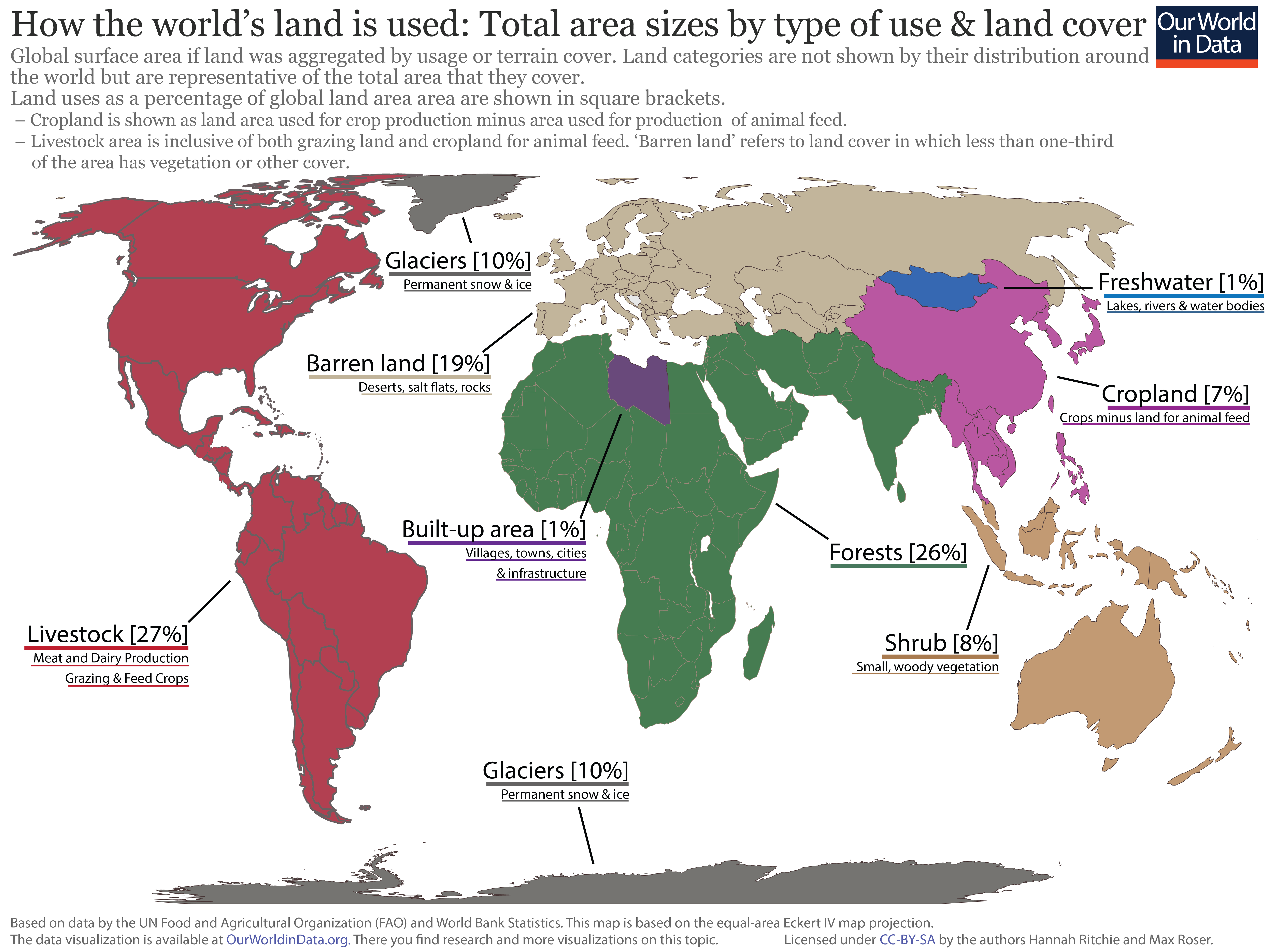
The unfortunate truth is that we have so heavily subsidized and centralized food production that anyone focusing on biodiversity, sustainability, or even animal welfare can compete economically.
If we care at all about any of these goals, let alone all three, the only solution seems to be a much more localized food system. Large-scale ranching and farming is heavily dependent on monoculture, i.e. growing only one type of crop or raising only one type of animal. Without this a farmer has a much harder time mechanising the process with heavy equipment, and that's a must give that exceedingly few people are willing to work on a farm. Even then, most farmers eek out a living based heavily on government subsidies and crop insurance.
I'm raising a small herd of cattle on pasture, I don't have as much experience farming crops so I'll stick with ranching here. Our cows are entirely grass fed and we don't use pesticides, herbicides, or antibiotics. We don't even own a tractor because it's not economically viable to take on the upfront or maintenance costs of modern tractors. No matter how I do the math I could never sell meat or dairy at prices that come close to grocery store prices.
And no, scale wouldn't solve the financial challenge. Raising healthy cattle on pasture requires much more land per head than industrial cattle production offers. Fertilizers, antibiotics, and pesticides are all additional inputs that require expensive equipment to apply properly and ultimately are just bandaids attempting to squeeze out more head per acre than the land can actually support. At the end of the day we would end up raising more cattle, but our expenses and risk would continue to grow at least as fast and we'd end up working harder and stressing out more just to make sure something doesn't go wrong and bring the entire house of cards down.